Showing posts with label Solar Power. Show all posts

Saturday, January 16, 2010

Kibera Community Youth Program’s Solar Project

by Nels Nelson

Wycliffe Sande of the Kibera Community Youth Program, shown here in his office with me, is organizing a solar energy program within the infamous Kibera slum of Nairobi. The program offers consultation and installation service for household PV panels and also builds small PV units to be sold within the community aimed at the target group of citizens without access to the electricity grid.

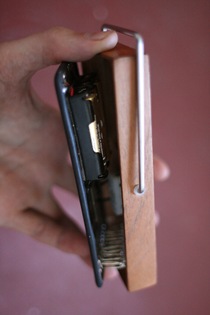
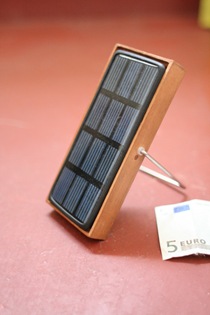
One of the products being developed is an integrated PV light system. The components are a hard crystalline PV panel (5.3 x 13.3cm) connected to a tray of three AA rechargeable batteries and then ten LED bulbs inside an FSC-certified hardwood case.

IMG_6676 IMG_6678 IMG_6680

The advantages of this design are that it can be assembled within the slum and the product is reasonably durable. The disadvantage are that it is too expensive to be purchased by slum dwellers (~30 Euro, equivalent to three months rent), it is not water resistant, and a few design flaws limit its practicality. The high cost is resultant from the PV panel, which is of Swiss make and costs over 6 Euro, and the FSC wood, which was recommended by Greenpeace. The light beam is quite focused (due to the deep inset of the LED bulbs) which limits the product’s ability to offer diffuse light in a room.

If you are a product designer with an inclusive worldview, I challenge you to redesign the product to reduce the price and improve functionality. I would consider using a less expensive PV panel, such as a flexible thin-film cell and replacing the wood with locally available recycled material, such as plastic packaging or rubber from tires or inner tubes. I would keep the idea of using recharchable AA batteries because it extends the use of the product to battery charging. The dream product should be able to illuminate a small shop window or a living room for at least four hours, offer water protection, cost less than 5 Euro, be able to be assembled within a slum workshop, use recycled or renewable materials for the casing, and last for many years.

Sande would love for you to offer a new design. Comment on this post and I can put you in touch with him.

Monday, January 19, 2009

Nieuwland, Amersfort, the Netherlands: Win? Fail?

Nieuwland is a housing development in the Netherlands of 5000 homes on about 75 hectares of greenfield. After being conceived in the 1980's as a sustainable community, it took many years to plan and is still expanding. "Sustainability" was achieved by a strong building code policy which enforces low-energy construction and necessitates solar panels. I had the chance to take a tour of the town during which I developed some strong reactions.

Win:
- Each section of the city is designed by one or more architects; each of whom took a very different approach to applying their mandatory solar panels. The result is a sort of solar panel design test facility. Some of the buildings look awful while others pull off the feat with charm.
- The radial street plan is walking and bicycling friendly.
- Canals and a small lake are great landscape elements.

Fail:
- Yuppy takover. Nieuwland fails to reach any socio-economic class other than middle-class families who are drawn to the quiet community for its safety and schools. "Everybody has two kids and two cars," said the tour guide. Boredom lays heavily in the air.
- A three meter earthen wall surrounds the entire community for "sound protection" but feels more like an attempt to make a gated community. By walling themselves in, connectivity is lost and further dependence on automobiles is created.
- The city center is literally a parking lot, depriving the inhabitants of a community feel.
- The one shopping center feels like Disney Land and lacks store variety. There are no street cafes or smaller shops interspersed in the community.
- There is too much street parking and personal garages. People drive into town center despite the bicycle lanes.

Nieuwland is relevant because it is a testing ground for sustainable building and a showcase for what can go wrong in city planning when mixed-use and mixed-economic class issues are not accounted for.

Sunday, January 11, 2009

Energy Collecting Mixed-Use Building


7 weeks to go until our entry for the SASBE2009 competition is due. This is a personal brainstorm for a large building which utilizes many renewable infrastructure technologies.

The building is designed to capture as much sun as possible for passive solar gain, growing food, and improved living conditions.

The north facing side will be utilized by functions which do not require direct sun, such as rainwater storage, food storage, and retail.

The structure's first level will be a series of archways allowing for open transportation and easy connectivity. In the northern portion of the building, a hole is cut through to create a public square and allow more light to fall into the living and working spaces.

Tuesday, July 29, 2008

#008000 California

California State green building standards adopted by the California Building Standards Commission on July 17, 2008.

Via Green Home Building and Sustainable Architecture
California has adopted the nation's first statewide green-building standards, which will become mandatory in 2010. The new California Green Buildings Standards Code requires builders to reduce energy use by 15 to 30 percent beyond current standards and use more recycled materials. Some of the code will be mandatory, while other parts are just suggested...
These new codes include basic passive solar mandates: "When site and location permit, orient the building with the long sides facing north and south. Provide exterior shade for south-facing windows during the peak cooling season. Provide vertical shading against direct solar gain and glare due to low altitude sun angles for east- and west-facing windows."

For renewable energy, the codes says, "Use on-site renewable energy sources such as solar, wind, geothermal, low-impact hydro, biomass and bio-gas for at least 1% of the electric power."

For water conservation, the code says, "A schedule of plumbing fixtures and fixture fittings will reduce the overall use of potable water within the building by 20%, and provide water efficient landscape irrigation design that reduces by 50% the use of potable water beyond the initial requirements for plant installation and establishment."

"Each building shall further reduce the generation of wastewater by one of the following methods: The installation of water-conserving fixtures (water closets, urinals) or utilizing non-potable water systems (captured rainwater, graywater, and municipally treated wastewater
(recycled water)."
Greenbiz.com - California Adopts Green Building Code for All New Construction
The code sets targets for energy efficiency, water consumption, dual plumbing systems for potable and recyclable water, diversion of construction waste from landfills and use of environmentally sensitive materials in construction and design, including eco-friendly flooring, carpeting, paint, coatings, thermal insulation and acoustical wall and ceiling panels.

Friday, July 18, 2008

Smart Energy Grids

Dispersed generation is a solution for greater electricity demand and an aging centralized generation system; micro local generators exporting energy could play a bigger part in power generation soon. Here is some information about upcoming "Smart Grid" ideas for facilitating local-made electricity:

Climate Change Corps

Power to the people

The key element of a smart grid is that, unlike a dumb one, it will be able to take power from multiple sources and distribute it according to demand so that optimum efficiency is achieved. There will be less reliance on massive power plants. Energy will be generated locally and fed into ‘intelligrids’ organised at municipal level, with surpluses being sold to other areas, according to demand.

Renewables will provide a far greater share of power than today. A farmer might have a wind turbine on his or her land, or a generator producing power from flowing water. Households might have mini wind generators on the roof. The goal, as Spencer Abraham, another former US energy secretary, recently said, is “a two-way electricity grid where homes or businesses can sell their surplus power back to the grid”.

Sophisticated software that accurately measures demand will monitor the network. Homes and offices will have meters that respond to peaks and troughs. The future grid has been compared to an ‘energy internet’ with ‘user-generated’ electricity feeding into it from every direction. US economist Jeremy Rifkin has christened the future power infrastructure the “intergrid”. Management of it, he has said, will be “the next IT revolution.”

Power Partners: Smart Grid Technology

World Changing

Smart energy grids are electrical power's killer ap. Smart grids manage supply from a variety of distributed sources - conventional power plants, but also solar, wind and hydro plants as well as people's home energy systems. They not only help prevent blackouts, they actively encourage alternative energy. Smarter, better, greener...
This all rocks pretty hard, but it gets downright seismic when you start to consider the implications for the developing world, where there is often no grid worth speaking of to replace. There, if we can get the price down enough, distributed energy and smart grids could do for power what cellphones have done for communications - leapfrog entire regions right over the 20th Century and into the 21st.

Bright Lights, Small Villages
Solar power and other decentralized sources of energy can help get around these problems. Mobile phones in Africa, Asia, and Latin America provide a hopeful parallel. For decades, people in developing nations had to put up with expensive and poorly designed telephone networks controlled by corrupt and inefficient bureaucrats. But over the past five years, entrepreneurs have built cellular-phone networks that, in effect, circumvent the national telephone system. Five years ago, Ghana didn't have mobile phones. But as a U.N. task force recently discovered, more cell phone connections have been turned on in Africa in the last five years than land-line
connections in the past century.
U.S. Department of Energy (Grid 2030 .pdf)
Grid 2030 is a fully automated power delivery network that monitors and controls every customer and node, ensuring a two-way flow of electricity and information between the power plant and the appliance, and all points in between. Its distributed intelligence, coupled with broadband communications and automated control systems, enables real-time market transactions and seamless interfaces among people, buildings, industrial plants, generation facilities, and the electric network.
"Towards Smart Power Networks"
European energy research is helping to transform the energy system into one which will be more sustainable and more compatible with the ecosystem. Within this framework, energy research is a key factor for the development of a sustainable European economy in the context of the Lisbon Strategy, a major priority for the European Union which is intended to boost competitiveness, job creation, social cohesion and environmental sustainability.
Wind generators, fuel cells, photovoltaic panels and micro-turbines – to mention just a few – are new forms of electricity generation currently being developed. They make up the so-called Renewable Energies and Distributed Generation; some of which are small or mediumsized, while others are intermittent or even stochastic. Today, wind power and Combined Heat and Power are reaching a competitive level with the traditional forms of energy generation. Maybe tomorrow we will be talking about micro-turbines, fuel cells and photovoltaics.

Better Generation (UK)
selling electricity to the grid

Assuming your house is connected to the national grid, you can sell any surplus electricity you generate back to your energy supplier, (although it is sometimes hard to get the appropriate red tape completed).

There are basically two options for selling your renewable energy back to your electricity supplier. If you're prepared to fill in a lot of forms it's possible to get paid the same price per unit exported as you pay to buy it off your supplier (net metering). Alternatively, there's an easier option where you get paid less per unit generated, but it's a lot less hassle.

the net metering option
If you've invested in some serious energy-generating kit, and you expect to produce a lot of surplus electricity, you'll want to set up a net metering arrangement. This means that your energy supplier will pay you a decent price for every spare kW of electricity generated that you don't need yourself. It does mean you'll need to get an OFGEM-approved Export Meter - your supplier may be able to help.
Take your power back! Cover your house in solar panels, it might be a worthwhile investment in your region.

Tuesday, June 17, 2008

Visit to a Karen Village in the Mae Hongson Valley

Near Mae Hong Son, Thailand

Along the curving mountains between Mae Hongson and Pai lies a small Lisu village called Ban Namrin. Lisu is a minority group originating from a northern province named Chang Rai that hugs China. There is a lodgement of small bamboo huts that is run by a Lisu and her German husband, who welcome us like grandchildren to their peaceful hidden estate. It is low season and they only received three guests in May. Amee and Rudi advise us to enjoy a 5 hour walk to Manora, a Karen village.

Early Saturday morning we leave, rain gear in hand, along 2kms of cement after which the road transcends into a muddy dirt road that runs along a river. Playful butterflies dance around us, and blueheaded lizards jump across our path. Sloped farms with tough bamboo fences to keep out trotting cows are worked by groups of women and men. Carrying barrels of pesticides, spraying each field kilometers wide by hand, a barrel at a time. In one field, five groups of three are seeding the field with rice. A man, quick handed, shovels a hole for a couple seeds of rice, which are thrown accurately by his relative, and the third treads behind dragging a thick leaved branch that smoothes the surface of soil. Hard work is done at Ban Look Pa Kor, a Lahu village.

A two-hour ascend takes our breath and the view atop the mountain pass at 1400meter is beautifully 'photographic'. [insert photo]. The path leads away from slopes of agriculture and hardwork, and takes us through a bewildered jungle; a most wild hairdoo.

We meet a group of young men cutting down a tree of two diameters wide with a single axe. The smallest axe head we'd ever seen. An alien tree had twisted itself around the trunk and was sucking out all life out of its mother. Further descending, we met an older man rifle in hand, one almost two meters long. He was walking the jungles with his five hunting dogs. He parted when taking a hidden jungle track through the thick jungle.

Planting food

Our path is sprinkled with a sporadic presence of cement; often at curviest up- and downhill twists. Empty bags of cement left to be eaten by the earth. Manora is a sparkling gem at the bottom of the pass.

At the school, we present a letter in Amee's handwriting asking for a night's stay. One of the older girls is on the know-how and takes us to an older couple. Opa is delighted to meet us and greets us with a smile of warmth, instead Oma just sighs... The village is made up of 40 families, all Buddhist Karen who speak Pho Karen, not Sa Karen that our Christian Karen student speak. Words do not overlap and our interactions are with gestures, nods and smiles. Opa prepares a pot of delicious hot tea, we drink from cups carved from a bamboo branch.

Manora Karen Village, Northern Thailand Manora Karen Village, Northern Thailand

We shower under the bridge at the edge of the village, to wash away mud and sweat. Upon our return we find a happy gathering at the house; a celebration with Rice Wine Manorita for the return of a son from Chiang Mai.

Opa is the key; he is the only villager who knows the way from Manora to Mae Hongson over the mountains and through the jungle; a four day journey.

Their home is 30 years old and is built high on stilts. A small porch divides the living room and kitchen, with their bedroom. The bathroom is an outhouse, and below we count 3 pigs and a number of piglets. Chicken are kept in baskets in a hut off to the side. Dishes are done outside in peils with water thrown between the cracks of wood planks. In fact, any extra tea, saliva or food scraps are thrown through the crack and provide a party atmosphere for the fatties below.

A rural development project funded by Hitachi has provided a solar panel and battery to every family in Manora. Electricity, thus, is not an issue.

Solar Panels in remote Thai village

Solar Panels in remote Thai village
A project sponsored by Hitachi gives each family a solar panel and battery in certain remote villages in Thailand. The community also receives a larger station and battery charger.

In the evening, opa relaxes by the fire and rests a sore knee. A soundful sleep was impossible, our mind trying to place the noises our ears record. Dogs eating out metal pots at the front, drunken brothers returning home. Opa and Oma rise before the sunrise and light the fire. A thick cloud of dew is a lid to the valley but when it opens we begin our journey up the mountain slope, leaving behind a drawing of our of gratitude.

Covet: Solar Bags

Do you need to charge your iPod, camera, GPS, and phone? But you are on a long trek, at a picnic, homeless, or in an area without constant electricity supply? A solar panel bag might be perfect for you. Most bags on the market charge to a battery with USB and 12 volt car-charger ports.

Noon Solar Bags' going price at the moment is around $450 for a bag. They look fantastic mixing old craft processes with new age ideas.


Eclipse Solar Gear makes the Fusion messenger bag sold for a much cooler $190. The style is urban but the panel looks small.


Juice Bags by Esc Outdoors go for $200 and look rugged enough for adventure. Built with a padded laptop sleeve and flexible ballistic nylon solar panels instead of solid panels, this could be a worthwhile solution.


The Generator by Voltaic Systems is the first solar bag powerful enough to charge a laptop. Rather impressive, but looks like carrying the deathstar. A bit expensive at $600. Voltaic also makes smaller and cheaper bags, but they look even worse.


Or, for the DIY-er in all of us, one could buy a flexible 12 volt solar panel and sew it into an existing bag. PowerFilm Inc. manufactures super thin and lightweight solar panels. Silicone Solar Inc. has a diverse line of consumer ready flexible solar panels, and they are waterproof. DIY Instructable on building a solar bag.