Nelsonelson.com has been updated to include the Myanmar-Thailand Border photo essay, the final product of my time living in the region.
Monday, August 18, 2008
Myanmar-Thailand Border: Photo Essay
Nelsonelson.com has been updated to include the Myanmar-Thailand Border photo essay, the final product of my time living in the region.
Tuesday, June 17, 2008
Visit to a Karen Village in the Mae Hongson Valley
Along the curving mountains between Mae Hongson and Pai lies a small Lisu village called Ban Namrin. Lisu is a minority group originating from a northern province named Chang Rai that hugs China. There is a lodgement of small bamboo huts that is run by a Lisu and her German husband, who welcome us like grandchildren to their peaceful hidden estate. It is low season and they only received three guests in May. Amee and Rudi advise us to enjoy a 5 hour walk to Manora, a Karen village.
Early Saturday morning we leave, rain gear in hand, along 2kms of cement after which the road transcends into a muddy dirt road that runs along a river. Playful butterflies dance around us, and blueheaded lizards jump across our path. Sloped farms with tough bamboo fences to keep out trotting cows are worked by groups of women and men. Carrying barrels of pesticides, spraying each field kilometers wide by hand, a barrel at a time. In one field, five groups of three are seeding the field with rice. A man, quick handed, shovels a hole for a couple seeds of rice, which are thrown accurately by his relative, and the third treads behind dragging a thick leaved branch that smoothes the surface of soil. Hard work is done at Ban Look Pa Kor, a Lahu village.
A two-hour ascend takes our breath and the view atop the mountain pass at 1400meter is beautifully 'photographic'. [insert photo]. The path leads away from slopes of agriculture and hardwork, and takes us through a bewildered jungle; a most wild hairdoo.
We meet a group of young men cutting down a tree of two diameters wide with a single axe. The smallest axe head we'd ever seen. An alien tree had twisted itself around the trunk and was sucking out all life out of its mother. Further descending, we met an older man rifle in hand, one almost two meters long. He was walking the jungles with his five hunting dogs. He parted when taking a hidden jungle track through the thick jungle.
Our path is sprinkled with a sporadic presence of cement; often at curviest up- and downhill twists. Empty bags of cement left to be eaten by the earth. Manora is a sparkling gem at the bottom of the pass.
At the school, we present a letter in Amee's handwriting asking for a night's stay. One of the older girls is on the know-how and takes us to an older couple. Opa is delighted to meet us and greets us with a smile of warmth, instead Oma just sighs... The village is made up of 40 families, all Buddhist Karen who speak Pho Karen, not Sa Karen that our Christian Karen student speak. Words do not overlap and our interactions are with gestures, nods and smiles. Opa prepares a pot of delicious hot tea, we drink from cups carved from a bamboo branch.
We shower under the bridge at the edge of the village, to wash away mud and sweat. Upon our return we find a happy gathering at the house; a celebration with Rice Wine Manorita for the return of a son from Chiang Mai.
Opa is the key; he is the only villager who knows the way from Manora to Mae Hongson over the mountains and through the jungle; a four day journey.
Their home is 30 years old and is built high on stilts. A small porch divides the living room and kitchen, with their bedroom. The bathroom is an outhouse, and below we count 3 pigs and a number of piglets. Chicken are kept in baskets in a hut off to the side. Dishes are done outside in peils with water thrown between the cracks of wood planks. In fact, any extra tea, saliva or food scraps are thrown through the crack and provide a party atmosphere for the fatties below.
A rural development project funded by Hitachi has provided a solar panel and battery to every family in Manora. Electricity, thus, is not an issue.
A project sponsored by Hitachi gives each family a solar panel and battery in certain remote villages in Thailand. The community also receives a larger station and battery charger.
In the evening, opa relaxes by the fire and rests a sore knee. A soundful sleep was impossible, our mind trying to place the noises our ears record. Dogs eating out metal pots at the front, drunken brothers returning home. Opa and Oma rise before the sunrise and light the fire. A thick cloud of dew is a lid to the valley but when it opens we begin our journey up the mountain slope, leaving behind a drawing of our of gratitude.
Monday, June 16, 2008
Pictures from the Road
Sitting in the palm of perfection. This large Buddha statue graces a mountain's summit near Mae Sariang.
Woman working in a field near Mae Sariang as part of Thailand's Otop campaign.
Staircase in Mae Hong Son ascending towards a Wat.
Panorama of the view from the top.
Tea tasting in Ban Rak Thai, a Chinese tea growing town in northern Thailand.
Another photo of Ban Rak Thai.
Forestry and agriculture research center in northern Thailand.
Photographic.
Guesthouse in Chiang Mai.
Another view of this room.
and many more at my flickr photostream
Monday, June 9, 2008
Control your naughty monkey mind
Chanting in the International Meditation Retreat [photo monkchat.net]
The brand-spanking-new Meditation Center, located in the middle of nowhere a half-hour from town, is what I would imagine a Scientology conversion compound to be like. A tall white fence around the perfectly manicured lawn cloisters a squeaky clean assembly hall, dormitory, dining hall, and watch tower (why? why is there a prison-style watch tower?). The landscaping and architecture is too modern and too sterile, leaving the atmosphere of an insane asylum which, when coupled with forty foreigners uncomfortably wearing sexless matching white pajamas with enforced silence, freaked me and many others right out.
Lessons were hit or miss. Before going to the Buddhist-meditation-crazy-person-spaceship, a very intelligent Cambodian monk lectured on the fundamentals of Buddhist philosophy for almost two hours. His interesting and informative discussion of morality, social code, and Siddhartha's life were a highlight of the experience. From the University campus, the forty bewildered Caucasian monkeys were squeezed into four vans and blasted off to another universe.
The five monks with one master gave lessons on the general drift of Buddhism, but I found the analogies and anecdotes un-fulfilling and generic. The way in which the master monk approached his teachings felt more like a missionary attempting to convert his tender flock of foreigners than an educative session on the techniques of proper meditation. That being said, we were introduced to sitting, standing, walking, and laying meditation. Walking meditation was conducted like a slow called dance with exaggeratedly long pronunciation of directions over loudspeaker, "Staaaaaaaaaanding. Staaaaaaaaaanding. Staaaaaaaaaanding. Intending to walk. Left foot gooooooooooooooo, stop. Right foot gooooooooooooooo, stop..."
Practicing walking meditation in creepy white robes.
If you are interested in experiencing this for yourself, the course is offered each Tuesday-Wednesday from Wat Soun Dok in Chiang Mai. The food is not half bad. More information on the Meditation Retreat Workshop page of monkchat.net
Saturday, June 7, 2008
Northwest Thailand Mae Sariang and onwards
Mae Sariang - Mae Hong Son - Ban Rak Thai (Tea Village) - Ban Namrin - Manora (Karen Village) - Pai - Chiang Mai. Details and photos to come later.
Wednesday, June 4, 2008
Timbuk2 Messenger Bag
Timbuk2 bag on the Minsk
Timbuk2 is a messenger bag manufacturer out of San Francisco. I have been toting their bag around for a while and snapped this shot of it resting on my Minsk. After posting it on Flickr with the appropriate 'timbuk2' tag, I was approached with a $100 gift certificate offer for use of the photograph, no terms & conditions, only written word that I will be credited.
I was happy to take their offer, excited at the opportunity of getting a new bag to replace my old beat up one. Once on their site, however, I found that few bags are sold for under $100, and all bags go for over $100 with shipping. I wrote back asking for a cool $190 to cover a new bag and shipping to Holland, otherwise, am I just being roped in for another purchase?
Another gripe; I emailed this photo directly to the marketing department of Timbuk2 and got no response. Only after opening a Flickr account and uploading the photograph with 'timbuk2' tagged on was I noticed. Strange Web2.0 action.
Nevertheless, it is encouraging to get some attention from the corporate world. Already I am starting to place my consumer goods next to temples and such to frame potential commercial photography.
Sunday, June 1, 2008
Mae Sot to Mae Sariang
Mae Sariang retains the air of a frontier town, part cowboy, part farmer, situated in the rural country on the extremity of Thailand. A small row of guesthouses and restaurants occupy prime real estate overlooking the Yuam River to entertain the relatively small population of tourists.
View Larger Map
Some may say this might be your last farewell ride
Minsk Motorcycle, "The Ox"
I spent an inglorious few hours neck deep in bureaucracy trying to figure out what becomes of the Minsk when we fly away June 19th. Eventually, the people in grey conceded and told me the truth, "Just leave, its not a problem. If they press you for answers, tell immigration you plan on returning." In May when I left Bangkok for Indonesia there were no questions about the bike, so I am willing to believe that when I leave again there will be no problems. The only question that remains is "Who gets the Ox when we go?"
Wednesday, May 28, 2008
AAPP Ex-Political Prisoner Portraits
AAPP Member
My friend Dan Welch (Conn College '05) is doing a piece on the ex-political prisoners living in Mae Sot. He asked me to do a couple of portraits, which I happily agreed to.
Living in Thailand to escape the junta, the AAPP members fear re-arrest by the Thai authorities on the street or at the market as the Thai Police make a habit of regularly arresting Burmese "Illegal Migrant Workers". One refugee ex-political prisoner confided in me that he always carries 300 Baht in his side pocket and fake papers just in case he is approached by police as he goes about his business in town so that he can bribe his way out of an ugly situation.
Note: the AAPP members consented to having these photographs published.
Sunday, May 25, 2008
Kwe Ka Boung School Information
Kwe Ka Boung School: Karen National Learning Centre
also spelled "Kway Ka Baung" and "Kwe Ka Baung"
The school was opened in 1990 by the school’s director. It gets financial support from Help Without Frontiers since 2003. Most of the parents work in and around Mae Sot in factories or on fields. Some of the parents live in Burma and send their children to Thailand for education. There is a small dormitory at the school where the children can stay. This year the school upgrades to grade ten.
Eline and I teach for one more week. On Monday, June 2nd the official school year starts, thus ending our summer program.
Fire erupts at compound of Myanmar embassy in Bangkok

Just as soon as Myanmar starts allowing international aid workers in, this happens:
The visa section of the embassy is located in the building that caught fire. In the last three weeks, aid workers and others often crowded into the section trying to obtain hard-to-get visas to isolationist Myanmar to help victims of a devastating cyclone. - APLink
Why did only the visa section of the embassy catch on fire for no reason? Last Friday Myanmar decided to open their borders to international aid workers, the following business day the door is re-shut by a mysterious fire. Smells fishy!
Sunday, May 18, 2008
Mae La Refugee Camp
As we walked along Mae La's main street, a dirt pedestrian road bordered by two story bamboo huts, a man came over a bridge ahead of us. I leaned over to Eline, "He looks rugged." Well-worn rubber boots, farmer's hat, and typically Burmese stout build. When his eyes caught us walking towards him, he stopped in his tracks, and covered his mouth. As we met he started becoming very emotional. His face read of long years working in fields and living in the jungle, wide and honest. After limp handshakes, his eyes fell misty upon us, and his chest started quaking. He made an action of a wave coming down onto his shoulders, perhaps Cyclone Nagris or an SPDC attack. He bisected his torso with his hand, pointed to one side and shook his hand away. Then he bisected my body and pointed at my better half, Eline. It would seem that he lost his wife. After the explanation, the strong "rugged" man fell into tears in front of us. I held his hand, but could offer very little verbal comfort. After our moment together, he blessed us and we parted ways.
Mae La is a vibrant, happy place full of playing children; home to about 40,000 refugees, mostly Karen minority. This encounter reminded us of the harsh reality facing the refugees not in Thailand by choice, but trying to make the best of it. 500,000 people are on the run from the Irrawaddy Delta and the Thai-Burma border camps are feeling the influx, though to what extent we are not sure.
The camp sits along a highway in a narrow valley surrounded by mountains and limestone cliffs. Inside its barb-wire fence, makeshift bamboo huts crowd over dirt paths and small streams. Australian, German, Japanese, American, and many other nations' flags decorate NGO walls. Schools and hospitals are extraordinarily prevalent. Churches, Buddhist temples, and Mosques belay diversity of religion living together in the camp.
Saturday, May 17, 2008
Kwe Ka Boung School
We started teaching English at a migrant school, the Kwe Kah Boung school for Karen kids, last Monday. It is supported by the Austrian NGO Help Without Frontiers. My students are between the age of 12 and 17, and for Nels between 16 and 20. The school is made up of two narrow buildings, unfortunately separated by a house in between. You enter through the restaurant and proceed up the stairs. First flight passed a make-shift bedroom, second passed three computers (always taken) with internet (chatting with e-boyfriends and e-girlfriends). The next flight takes you to my classroom, where students wait for our arrival and greet us with "Hello Teacher." Proceeding further up the stairs, takes you to where Nels teaches: the roof. Follow the gutter and climb down the stairs to reach the other network of classrooms.
The children begin with a choreographed welcome in chorus, "Karen, Karen, Karen, Good afternoon Teacher," I return the monumentous prayer with "Thank you Students. Good Afternoon. Please sit down." I then proceed to ask, "What did you do this morning?" which stuns the young audience and they pick at the hems of their jackets (the temperature drops significantly after each rainfall, though it is still a warm 34*C), and avoid the teacher's eye. The students have a relatively wide vocabulary, but are reluctant to put ideas into sentences. To my delighted surprise, the students drool over dictation, a discovery directly resulting from panic: when a planned exercise fails and there is still an hour and a half of classtime to fill. So I plan to cook a big stew of alphabet soup next week. Students make mistakes like "She has a long hair," and after five days of pounding and genetic modification, I still meet sentences like "She has a long hair," and "She wear shirt green." Frustration builds, but foundation weakens every time class finishes and a student remains behind to carry down the Escher-inpsired stairwell my journal and whiteboard marker. Though, conversation in class is not free-flowing, the Karen culture is exposed through their short-stories, descriptions and drawings.
Students are deliciously adorable, and after five times two hours, we are drawn to each other. Nevertheless, I am relieved that the weekend has come: to recooperate! However, the peacefullness of the weekend has been rudely interrupted by the jack-hammering on the concrete that finally reached the sidewalk in front of our guesthouse. The sound is demoralising. Unfortunately, we cannot direct our anger at the exploited road side worker (geared with flipflops and super invisible earplugs), as he only earns 50baht per meter of sidewalk. He probably accomplishes three meters, he works from dawn til dusk...
We are staying at a guesthouse, 150baht per night for a double. We have rigged it out and it is home, with a porch. Mangoes and Mangastines are currently in season, so we are enjoying mangoes at 5 baht (15 US cents) A KILO!! We are embarrassed to say that we are almost mangoed-out.
Wednesday, May 7, 2008
Winds of Change
The current plan is to move to Rangoon (aka Yangon) as soon as possible. A Katrina-sized cyclone unexpectedly jumped out of the Bay of Bengal into the Irrawaddy River Delta killing an estimated 10,000 people and making over a million homeless. In Yangon, the capital city to the East of the river delta, 59 people were killed and major damage done to the infrastructure.
In the Bangkok airport, news agencies have personnel holding signs directed at tourists returning from Yangon asking for any photos coming from the region. There is a huge lack of information coming from within. A task for me? Perhaps.
The national referendum vote for the pro-junta constitution was scheduled on May 10th. This date will be upheld in the majority of the country except in the disaster areas where voting will be pushed back to May 24th. Due to the secretive nature of SPDC, the controlling junta, relief workers including UN employees are being denied visas until after the referendum vote, I am told.
In the coming weeks Eline and I are going to try a few avenues for visa acquisition though it sounds like we will have to wait just like everyone else. Using Mae Sot contacts, we are going to get in touch with a school in Yangon for the opportunity to obtain 10 week work visas. Meanwhile, a boarding school on summer holiday needs some sort of summer classes to entertain a gaggle of kids too far from home to return for break.
Indonesian photos soon!
Tuesday, April 22, 2008
Ode to Thaimes Bar
Win and Tway, most excellent bartenders
From my first unsure entrance into Thaimes Bar, I have been made to feel at home by the two friendly bartenders Win and Tway as well as the interesting mixing pot clientele of NGO workers and Burmese. Like Cheers, its nice to go where everyone knows your name, and where you know your friends will be if they feel like being social that evening. The atmosphere is buttressed by a triangle-pillow and low table seating area, a ten foot snooker table, darts, and a patio. No prostitutes are tolerated to come in, so the problem of having working girls (or lady boys) bothering you is eliminated.
I have fostered many friendships here with different NGO volunteers and workers. Dutch, English, Canadian, Australian, German personalities stir up interesting conversation with varied worldviews. At Thaimes, we can vent frustrations about the NGO lifestyle, enjoy humorous aspects of living in Mae Sot, or put together future work connections.
Never before have I been to an establishment that has treated its guests like family. Win and Tway deliver great service, but bar self service is allowed as well. In the spirit of trust, payment is not expected every night instead tabs can extend for weeks. Win has a habit of serenading friends with guitar and song until the early hours of the morning while Tway is usually eager to hold down his title of snooker champion. The hours of Thaimes are flexible, meaning if patrons are willing to stay until eight in the morning, it stays open. I have taken this road once or twice on a Friday. At sunrise the monks start walking the streets for alms which is a good heads up that it is time to run home.
Although unadvertised, all proceeds from Thaimes Bar support a local school for migrant children. Legend has it that there are 3 founding fathers, 2 NGO workers who wanted to support the school and also a 22-year-old professional online poker player who was passing through and dropped $2,000 on the project, but this is unverified information.
Win singing in Burmese
Saturday, April 19, 2008
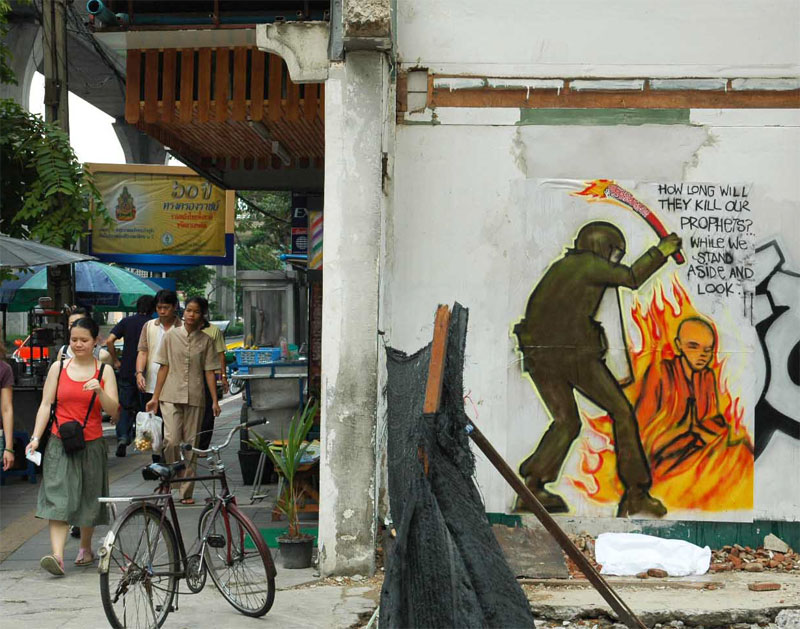
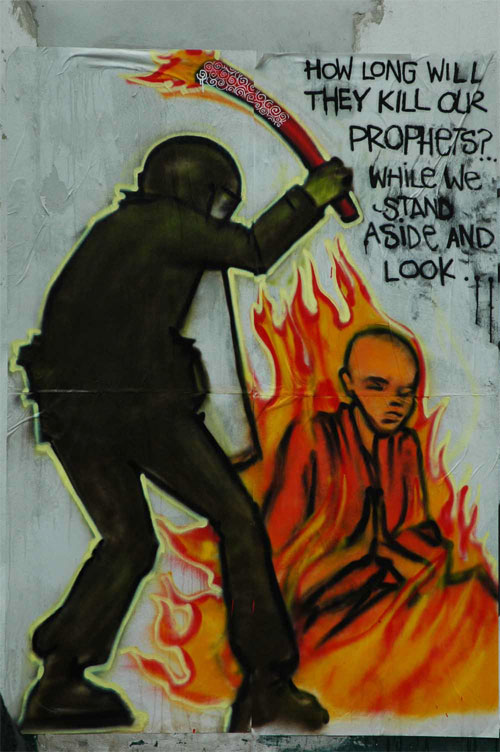
Anti-Olympic Graffiti On The Streets of Bangkok, Thailand
from Wooster Collective
Chris in Bangkok sent us these photos today of Anti-Olympic touch graffiti seen on the streets of his city. The Olympic torch relay will pass through the city today but the government has banned all protests.
Bumps in the road
Thankfully, there will be solace next week when I take my "forced vacation" to Manila, Philippines, with Eline who is meeting me Bangkok as she arrives from Australia. The visa scene here is strange:
30 day entry visa
+ 2 renewals
= 90 days
after this you must leave the country and apply for a tourist visa, typically 60 days, though at the digression of the custom's officer. This can be purchased to be multiple entry as well, so you get the following:
60 day tourist visa
+ 2 renewals
= 180 days
When your tourist visa runs out, you can go back onto the entry visa plan, and then eventually be forced to leave the country for another "forced vacation", so now I hope you understand the situation.
We are going to spend 10 days in the Philippine islands hopefully swimming with the fishes and drinking rum in the shade!
Wednesday, April 16, 2008
Two Pieces of Poignant News
Myanmar's gas exports to Thailand earn 2.7 billion dollars in 2007
Apr 8, 2008, 3:42 GMT Yangon - Myanmar, which faces economic sanctions in the West because of its poor human rights record, earned 2.7 billion dollars from natural gas exports to Thailand last year, media reports disclosed Tuesday. In 2007, Myanmar's total trade hit an historic peak of 8.7 billion dollars, split into 5.9 billion exports and 2.8 billion in imports, leaving the country with a trade surplus of 3.1 billion, said the Myanmar Times weekly, citing government officials. Myanmar's exports last year were driven primarily by natural gas, which earned the impoverished country 2.7 billion dollars, or 45 per cent of its total exports. 'The major reason why Myanmar's trade volume is increasing is the massive contribution form the energy sector - the export of natural gas to Thailand,' said Maung Maung, an economist and researcher from Economic Studies and Research Institute, the Union of Myanmar Federation of Chambers of Commerce and Industries (UMFCCI). Natural gas exports have risen dramatically since 2002, when Myanmar first opened a pipeline to deliver gas from offshore reserves in the Gulf of Martaban to Thailand. 'As a result, Myanmar has enjoyed consecutive trade surplus since 2002,' said Myanmar's Commerce Minister Brigadier General Tin Naing Thein in a recent interview. Besides natural gas, Myanmar's main export items last year included agricultural products, amounting to 572 million dollars in earnings, gems and jewellery to 561 million, and fishery products to 366 million. The country's main imports were fuel, which cost 471 million, followed by textiles at 276 million, palm oil at 251 million, machinery parts at 243 million, and automobiles at 192 million. Most multilateral lenders such as the World Bank and Asian Development Bank, severed their programmes with Myanmar in 1988 following a brutal military crackdown on a pro-democracy movement that left more than 3,000 people dead. The US forbid its private sector from investing in the country in the early 1990s, after the ruling junta refused to acknowledge the outcome of the 1990 general election, and the European Union has placed visa restrictions on the regime's rulers. US and EU Sanctions were tightened after another crackdown on protesters in September, when a sudden doubling of fuel prices prompted demonstrators, led by Buddhist monks, to take to the street on Yangon. The latest incident left at least 31 dead, according to official estimates.Asia-Pacific News
North Korea has reportedly been exporting multiple-tube rocket launchers to Myanmar, in violation of UN sanctions.
Diplomatic sources told NHK that the exports began last year after the 2 nations restored diplomatic ties, and have been carried out through a Singapore-based trading company.
North Korea and Myanmar cut diplomatic ties in 1983, when South Korea's former President Chun Doo Hwan was targeted in a terrorist bombing in Myanmar's capital.
Myanmar, then Burma, blamed the attack on North Korean agents. But the 2 nations normalized diplomatic ties a year ago for the first time in 24 years.
The rockets used with the launchers are said to measure 240 millimeters in diameter and about a meter in length, and have a range of about 65 kilometers.
North Korea is believed to have a number of such multiple-tube launchers deployed along the demilitarized border with South Korea.
The UN Security Council adopted a sanctions resolution against North Korea following its nuclear tests in October 2006. The resolution bans the country from exporting or importing nuclear material, ballistic missiles and other types of conventional weapons.
The reports of North Korean exports of weapons to Myanmar, a fellow military dictatorship, has raised concerns in the United States and South Korea.
North Korea has been cut off from international economic assistance due to a deadlock in the six-party talks on its nuclear disarmament.
Tuesday, April 15, 2008
Water Festival, I'm over it
The first stop of the caravan was of particular interest. We traveled 30km to a rose plantation to pick up some friends and picnic. The fields were exceptionally beautiful even though the roses had not all bloomed. A network of dirt roads navigated through the vast area to small pockets of thatched and corrugated steel shanties. 500 Burmese migrant workers were distributed through the plantation living permanently. They rose at 6:30 to begin picking as to squeeze in a half day of work before festivities, grossing $1 instead of their typical $2 for a day's work. One Karen worker had a university degree from Rangoon and spoke good English, so we talked about life in the fields. He was proud of a small side garden that the landlord allowed where he grew some vegetables to eat and sell at market to bolster his income. The biggest problem facing the 500 workers, he told me, was total lack of education for their children. An NGO is attempting to start a school, but first must make terms with the landlords.
Here is a quick run-down of my Water Festival Experience:
- Day 1: Exciting, new, fun!
- Day 2: Still digging it, more people throwing water than Day 1.
- Day 3: Little tired of getting wet, the Thai boxing was great though.
- Day 4: Totally over spending all day wet, ended the day worn out and with a headache.
- Day 5: Unwilling to have water thrown at me, placed myself under house arrest until sunset. Some foreigners plan vacations away from Thailand at this time of year, I don't blame them.
During Water Festival in Thailand alone:
324 dead
4884 injured
3955 traffic accidents
of course these are only the documented incidents, 2008
Monday, April 14, 2008
Bare Knuckle Kick Boxing, Thailand vs. Burma, Water Festival 2008