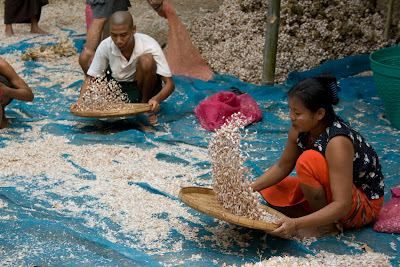
Nelsonelson.com has been updated to include the Myanmar-Thailand Border photo essay, the final product of my time living in the region.
Monday, August 18, 2008
Myanmar-Thailand Border: Photo Essay
Nelsonelson.com has been updated to include the Myanmar-Thailand Border photo essay, the final product of my time living in the region.
Sunday, June 1, 2008
Mae Sot to Mae Sariang
Mae Sariang retains the air of a frontier town, part cowboy, part farmer, situated in the rural country on the extremity of Thailand. A small row of guesthouses and restaurants occupy prime real estate overlooking the Yuam River to entertain the relatively small population of tourists.
View Larger Map
Thursday, May 29, 2008
Sheltering from Rain in Myanmar
Early morning, Eline left on a solo expedition to renew her visa. Passport control, on the Entry Port of the Union of Myanmar, is run by excessively friendly officers, one of which catches me in my pre-coffee confusion of whether to stand or sit. Passports are kept at the office... for our own safety of course.
On the Burma side, it is business as usual, as if it were any other border crossing in the world. Ants hard at work. Busy bees scoring a couple thousand Kyat (local currency). "Minglaba! Hello!" come from far and wide, off the sidewalk and from inside shops. Friendly faces greet the sleepy foreigner and stir life back into my dreamy estate.
"Ommo," is my driver for the day and he pushes me through the city of Myawaddy in a Burmese cyclo; a multifunctional wheelbarrow, suitable to transport matter and masses. The roads off the well-built main road are plackarded with signs reading "Crime free week" and "City of Myawaddy works together to eradicate problems of drug use". Farther from main cement, roads quickly deteriorated into pot-holes and dirt.
Unfortunately, economic strains are revealed through foods and bricks of Kyat bills locals carry (a stipling inflation). Roti Myawaddy comes without a rich serving of condensed milk as is the norm throughout Thailand. Samosas, too, lack a variety of vegetables, and ones I taste, with a watered down chilli sauce, were made of onion. I am confident to say that a lack of sweetness and richness in food breeds evidence of limited economic wealth.
Sheltering from the rain at a coffee shop, I become witness to the military face of Burma. A policeman at a table adjacent jumps up to regulate traffic. All traffic is forced to turn left. Several more policemen join, each geared with a masschetee, gun, and a pocket reading "US" (Is it fake or donated?). The commotion is for the locomotive of military vehicles that drive by wrecklessly, jeeps loaded with six to seven men and a centered machine gun.
Ommo takes me to a temple built on top of a giant green crocodile. It is a men's sanctuary so women are forbidden to walk the bridge. Pas de problemes, as instead I become enthusiastic for the opportunity that has presented itself otherwise: bearing witness to hundreds of water bottles that have been donated by the Thai government and which are being loaded onto a truck, ready for transportation to the Irrawaddy delta. Due to the rain, many delays are expected. Shibube (Thank you) Thailand.
However, the view of each temple top is gratifyingly calming with mountains scenting the horizon with an assured everlasting persence, with golden wats spirituality and collective hope to remain united against irreputable behaviour of a disgusting regime.
Wednesday, May 28, 2008
AAPP Ex-Political Prisoner Portraits
AAPP Member
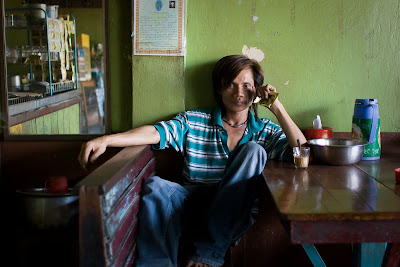
My friend Dan Welch (Conn College '05) is doing a piece on the ex-political prisoners living in Mae Sot. He asked me to do a couple of portraits, which I happily agreed to.
Living in Thailand to escape the junta, the AAPP members fear re-arrest by the Thai authorities on the street or at the market as the Thai Police make a habit of regularly arresting Burmese "Illegal Migrant Workers". One refugee ex-political prisoner confided in me that he always carries 300 Baht in his side pocket and fake papers just in case he is approached by police as he goes about his business in town so that he can bribe his way out of an ugly situation.
Note: the AAPP members consented to having these photographs published.
Sunday, May 25, 2008
Fire erupts at compound of Myanmar embassy in Bangkok

Just as soon as Myanmar starts allowing international aid workers in, this happens:
The visa section of the embassy is located in the building that caught fire. In the last three weeks, aid workers and others often crowded into the section trying to obtain hard-to-get visas to isolationist Myanmar to help victims of a devastating cyclone. - APLink
Why did only the visa section of the embassy catch on fire for no reason? Last Friday Myanmar decided to open their borders to international aid workers, the following business day the door is re-shut by a mysterious fire. Smells fishy!
Wednesday, May 21, 2008
Burmese Water Colors
Maung Maung Tinn is an exceptionally talented painter living in Mae Sot. He is a Karen and has been living in exile since 1995. I had the chance to see his most recent work, a photo realistic portrait of two young Karen with a branch coming down in the background. He pointed to one of the many leafs on the branch and said it alone took three hours to paint.
Monday, May 19, 2008
Cyclone Nagris: Myanmar Citizen Journalism
In the wake of Cyclone Nagris the international media has had a hard time getting into the Irrawaddy Delta to capture some images. Recently, a few Burmese citizens' videos and photographs have surfaced graphically depicting the damage. Via ABITSU (All Burma I.T. Student's Union) we are given this video from Laputta, one of the most heavily hit areas. It shows massive devastation and copious amounts of floating dead bodies.
Salai Thang captured photographs of the damage and the dead at the time of the cyclone and has posted them to this photo album.
The uncensored and graphic nature of these media pieces stands in direct opposition of the SPDC junta's media claims about the cyclone.
Wednesday, May 7, 2008
Winds of Change
The current plan is to move to Rangoon (aka Yangon) as soon as possible. A Katrina-sized cyclone unexpectedly jumped out of the Bay of Bengal into the Irrawaddy River Delta killing an estimated 10,000 people and making over a million homeless. In Yangon, the capital city to the East of the river delta, 59 people were killed and major damage done to the infrastructure.
In the Bangkok airport, news agencies have personnel holding signs directed at tourists returning from Yangon asking for any photos coming from the region. There is a huge lack of information coming from within. A task for me? Perhaps.
The national referendum vote for the pro-junta constitution was scheduled on May 10th. This date will be upheld in the majority of the country except in the disaster areas where voting will be pushed back to May 24th. Due to the secretive nature of SPDC, the controlling junta, relief workers including UN employees are being denied visas until after the referendum vote, I am told.
In the coming weeks Eline and I are going to try a few avenues for visa acquisition though it sounds like we will have to wait just like everyone else. Using Mae Sot contacts, we are going to get in touch with a school in Yangon for the opportunity to obtain 10 week work visas. Meanwhile, a boarding school on summer holiday needs some sort of summer classes to entertain a gaggle of kids too far from home to return for break.
Indonesian photos soon!
Wednesday, April 16, 2008
Two Pieces of Poignant News
Myanmar's gas exports to Thailand earn 2.7 billion dollars in 2007
Apr 8, 2008, 3:42 GMT Yangon - Myanmar, which faces economic sanctions in the West because of its poor human rights record, earned 2.7 billion dollars from natural gas exports to Thailand last year, media reports disclosed Tuesday. In 2007, Myanmar's total trade hit an historic peak of 8.7 billion dollars, split into 5.9 billion exports and 2.8 billion in imports, leaving the country with a trade surplus of 3.1 billion, said the Myanmar Times weekly, citing government officials. Myanmar's exports last year were driven primarily by natural gas, which earned the impoverished country 2.7 billion dollars, or 45 per cent of its total exports. 'The major reason why Myanmar's trade volume is increasing is the massive contribution form the energy sector - the export of natural gas to Thailand,' said Maung Maung, an economist and researcher from Economic Studies and Research Institute, the Union of Myanmar Federation of Chambers of Commerce and Industries (UMFCCI). Natural gas exports have risen dramatically since 2002, when Myanmar first opened a pipeline to deliver gas from offshore reserves in the Gulf of Martaban to Thailand. 'As a result, Myanmar has enjoyed consecutive trade surplus since 2002,' said Myanmar's Commerce Minister Brigadier General Tin Naing Thein in a recent interview. Besides natural gas, Myanmar's main export items last year included agricultural products, amounting to 572 million dollars in earnings, gems and jewellery to 561 million, and fishery products to 366 million. The country's main imports were fuel, which cost 471 million, followed by textiles at 276 million, palm oil at 251 million, machinery parts at 243 million, and automobiles at 192 million. Most multilateral lenders such as the World Bank and Asian Development Bank, severed their programmes with Myanmar in 1988 following a brutal military crackdown on a pro-democracy movement that left more than 3,000 people dead. The US forbid its private sector from investing in the country in the early 1990s, after the ruling junta refused to acknowledge the outcome of the 1990 general election, and the European Union has placed visa restrictions on the regime's rulers. US and EU Sanctions were tightened after another crackdown on protesters in September, when a sudden doubling of fuel prices prompted demonstrators, led by Buddhist monks, to take to the street on Yangon. The latest incident left at least 31 dead, according to official estimates.Asia-Pacific News
North Korea has reportedly been exporting multiple-tube rocket launchers to Myanmar, in violation of UN sanctions.
Diplomatic sources told NHK that the exports began last year after the 2 nations restored diplomatic ties, and have been carried out through a Singapore-based trading company.
North Korea and Myanmar cut diplomatic ties in 1983, when South Korea's former President Chun Doo Hwan was targeted in a terrorist bombing in Myanmar's capital.
Myanmar, then Burma, blamed the attack on North Korean agents. But the 2 nations normalized diplomatic ties a year ago for the first time in 24 years.
The rockets used with the launchers are said to measure 240 millimeters in diameter and about a meter in length, and have a range of about 65 kilometers.
North Korea is believed to have a number of such multiple-tube launchers deployed along the demilitarized border with South Korea.
The UN Security Council adopted a sanctions resolution against North Korea following its nuclear tests in October 2006. The resolution bans the country from exporting or importing nuclear material, ballistic missiles and other types of conventional weapons.
The reports of North Korean exports of weapons to Myanmar, a fellow military dictatorship, has raised concerns in the United States and South Korea.
North Korea has been cut off from international economic assistance due to a deadlock in the six-party talks on its nuclear disarmament.
Monday, April 14, 2008
Bare Knuckle Kick Boxing, Thailand vs. Burma, Water Festival 2008

Thursday, April 10, 2008
Life in Mywaddi

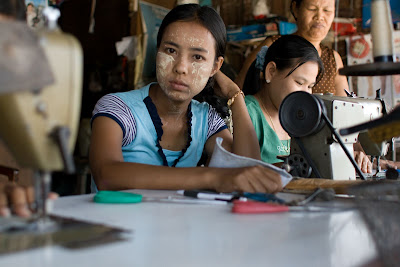
After coffee, I walked the street, checked out a market, and bought a light collared shirt. While making my way back to the Friendship Bridge, I came across a small sweat shop open to the road employing five girls to embroider patterns onto jean pockets. I stopped to say hi, and ask if they could embroider something onto my hat! The older gentleman manager took the job personally, and wrote with blazing red thread "Sun" in Burmese on the side of my cap while I snapped some photos of his workers. He would not accept any money.
Thursday, March 27, 2008
Haphazard Architecture on the Meoi River
Tuesday, March 25, 2008
John Rambo devastates the SPDC!
We picked up a free copy of the new Rambo movie that is being widely distributed in Mae Sot, what a riot! "Rambo! Rambo! Rambo!" chant from the Karen I live with as he shot, stabbed, and exploded entire battalions of the military junta.A few interesting notes on the movie, from the Karen point of view. All of the soldiers pretending to be junta are none other than members of the All Burma Student Democratic Front (ABSDF), a militant opposition group. The battalion leader or whatever, the head bad guy, is a well known ABSDF general; what a treat, to play your archenemy in such a film (and I thought the acting was pretty good). In a few scenes John Rambo breaks out some Karen and Burmese with good pronunciation I was told. Not surprisingly, the movie has been outlawed inside Myanmar, but bootleg copies are floating around. Finally, unhappily I was told that the atrocities committed by the SPDC in the film are not exaggerations of reality, they truthfully represent villages being burnt and pillaged.
Sunday, March 23, 2008
Migrant workers of the Meoi River
![]() |
| From Meoi River Mi... |
Saturday, March 22, 2008
Shedding more light on the Myanmar situation
Analogously, divisions between Myanmar and its bordering nations prior to WWII were unimportant. The British East India Company slowly expanded to the whole of Burma. By 1886, Burma was annexed to India, then became a separate colony in 1937, but important borders were never established. For example, people of the Karen ethnicity who live on what is now the Thai-Myanmar border, the Meoi River, historically operated on both banks of the river. However, after WWII the Meoi River seemed like a good arbitrary border between the two new nations and thus the Karen people were divided into two countries.
Dozens of ethnicities with over a hundred different languages and three hundred different dialects were thrown together along unrealistic boundaries into a new nation. Without any sense of unity, it has been exceedingly easy for the Myanmar junta, powered by the ethnic majority Burmans, to "divide and conquer" the various factions and thus rule them with little to no rights
while funding their regime with the land's plentiful natural resources. Oil and natural gas are piped from Myanmar's coast directly to India and China. When the junta (called the SPDC), is in need of funds, they auction off millions of dollars of gems, mostly to China.
While the UN and the US have economically sanctioned Myanmar, China and India, the two most populated countries, continue to trade, taking advantage of cheap resources to fuel their own economies. This is also strategic, as if one or the other super-powers were to cease relations with Myanmar, the other with indubitably exert tremendous influence on the only nation separating the two. As a result, the junta is propagated and becoming richer. With the millions of dollars of oil revenue, they purchase MiG fighter jets, more guns, and train more troops while the majority of the population of 58 million lives without education, health care, or even roads.
To say its "all England's fault" is hardly fair; the Myanmar situation seems almost inevitable after the solid nation-state borders of India, China, and Thailand boxed such a diverse loose collection of people together who previously never had outside authority exerted upon their small tribal cultures.
In this map of the states and divisions of Myanmar, notice the bright yellow division in the east; this is the Karen State which has many divisions within it. Linguists from one village to the next cannot understand each other. There are two separate warring armies, the Karen National Liberation Army and the Democratic Karen Buddhist Army. The DKBA has signed a cease-fire with the junta and has turned against the KNLA, showing just how miserable the factionalism is even within a state.Myanmar, for me, is a case of too much diversity in a world where diversity is considered a golden truth to be put in a special box and saved forever. Like it or not, Myanmar people are stuck together inside their country and need to find unity amongst themselves before they can hope to influence the junta controlling them.
Sunday, March 16, 2008
Thursday, March 13, 2008
Mywaddi, Myanmar

On March 11th I crossed the Friendship Bridge into Myanmar for the 1st time to renew my passport for another month in Thailand. The officials on the Myanmar side were extremely friendly, and allowed me to leave my passport at the office while I wandered around the border town for 2 1/2 hours until 5 when the border closed.
An english speaking 'translator' aka city guide picked me up immediately for a walk about. The first thing that struck me about the opposite side of the river, the Burma side, was the total lack of corporate businesses. The vibe of a closed country like Burma or Cuba is remarkable, no 7-11s, no cell phone hawkers, &c. Everything was pre-1950s or handmade.
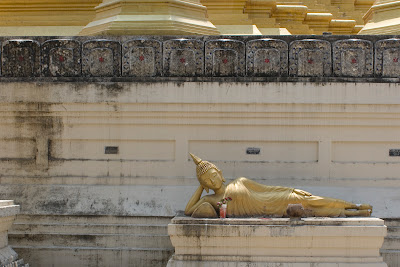
It also became evident the extent to which Burmese reverent Buddhism and their monks, the city and country side are littered with impressive golden stupas and their subsequent monasteries. The most impressive of which topped a hill and the slope leading up to it held 108 three meter tall pillars with a golden seated buddha, 108 being the number of beads on a prayer necklace. Now, the Saffron Revolution (see; September 2007 monk's protest) is put into context, the monks hold considerable political power in this country.
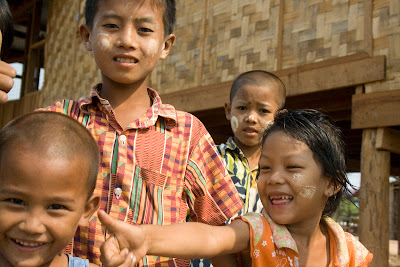
My guide and I dashed around the city from stupa to stupa, stopping in a few slums for photos of families and children; it was obvious he had led many photojournalist-wannabes around, and knew how to cater to their desires. On the way out he led me through a jungle of vendors and umbrellas at the night market, then we split ways.
Other good news, the Minsk is renewed for another 6 months in Thailand.
Monday, March 3, 2008
The Irrawaddy News Magazine
An excellent source of information for Burma and surrounding area, very professional, The Irrawaddy, named after main watershed in Burma. Based in Oslo, Norway, the Democratic Voice of Burma, an international television network, also has good stuff, and nightly airings of Mr. Bean, to our liking. Additionally, there are hundreds of websites and blogs dedicated to "the movement" towards democracy.