Saturday, January 16, 2010

Kibera Community Youth Program’s Solar Project

by Nels Nelson

Wycliffe Sande of the Kibera Community Youth Program, shown here in his office with me, is organizing a solar energy program within the infamous Kibera slum of Nairobi. The program offers consultation and installation service for household PV panels and also builds small PV units to be sold within the community aimed at the target group of citizens without access to the electricity grid.

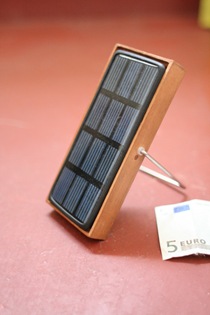
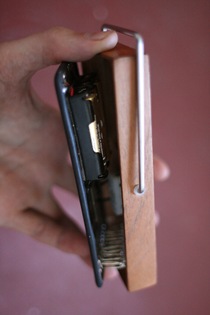
One of the products being developed is an integrated PV light system. The components are a hard crystalline PV panel (5.3 x 13.3cm) connected to a tray of three AA rechargeable batteries and then ten LED bulbs inside an FSC-certified hardwood case.

IMG_6676 IMG_6678 IMG_6680

The advantages of this design are that it can be assembled within the slum and the product is reasonably durable. The disadvantage are that it is too expensive to be purchased by slum dwellers (~30 Euro, equivalent to three months rent), it is not water resistant, and a few design flaws limit its practicality. The high cost is resultant from the PV panel, which is of Swiss make and costs over 6 Euro, and the FSC wood, which was recommended by Greenpeace. The light beam is quite focused (due to the deep inset of the LED bulbs) which limits the product’s ability to offer diffuse light in a room.

If you are a product designer with an inclusive worldview, I challenge you to redesign the product to reduce the price and improve functionality. I would consider using a less expensive PV panel, such as a flexible thin-film cell and replacing the wood with locally available recycled material, such as plastic packaging or rubber from tires or inner tubes. I would keep the idea of using recharchable AA batteries because it extends the use of the product to battery charging. The dream product should be able to illuminate a small shop window or a living room for at least four hours, offer water protection, cost less than 5 Euro, be able to be assembled within a slum workshop, use recycled or renewable materials for the casing, and last for many years.

Sande would love for you to offer a new design. Comment on this post and I can put you in touch with him.

Thursday, December 10, 2009

Deter Thieves By Uglifying Your Camera

Deter Thieves By Uglifying Your Camera

I am thinking about doing this for traveling in Kenya. Seems like a good idea since Eline said that she wanted disposable cameras, since they are not objects of desire for thieves. Yet, I must admit that I will still want to shoot digital.

Thursday, December 3, 2009

Legalized squatting in The Netherlands: in action

File: Okupa.svg

For several decades, squatting has been legal in The Netherlands.  A building or flat can be squatted which has been vacant for more than one year and if there is no building or renovation permit signed.

However, legalized squatting is probably in its twilight, as the Christian-conservative party (VVD) hopes to pass an anti-squatting bill this year.  Before the bill passes, two foreigners partook in this Dutch social experiment, and this is how they did it.

The first step was education about squatting laws and searching for a vacant building.  Education about squatting was taught by practicing squatters and the man behind Squatnet Rotterdam and the Autonomous Library, which yielded the best and most reliable information.  After spending many weekends scouting vacant buildings by bicycle, two or three buildings were recommended to us by Rotterdam natives.  The difficulty in finding a suitable building is not finding just an empty place, but having proof that it has been empty for at least one year.

The building we finally decided upon was very low-risk; it had already been squatted once before (though when abandoned it was reclosed), the owner was known for being respectful of squatters, and there were no redevelopment plans (in fact the final destination is demolition).  Additionally, a friend provided documents proving that it had been empty for more than one year.  For other buildings we looked at, we used the free resource at the City Information Point wherein the owner of any building can be ascertained.

When it comes to squatting, the only illegal activity is breaking and entering.  Dutch law states that once inside the building, if no damage from breaking and entering can be seen, and there is a bed, table and chair present and the door can be locked from inside and out, the occupants of the building have what is called House Peace.  Once House Peace has been established, the occupants become tenants of the building and assume the appropriate rights.

In our case, an open window provided the opportunity to enter without breaking.  Once inside the building, we removed the metal security door and built a new front door lock and installed our appropriate furniture.  After this, it is advisable to inform the police so that they can document the House Peace, after which anyone else coming into the house is trespassing, including the owner.  The police took about five days before they finally visited our squat, before which at least one person was always inside the building, should any mischief arise.  When the police finally arrived, they checked to make sure that the house was livable and that we seemed like decent people.  On their way out, one officer said, “Welcome to the neighborhood.”

We were lucky with the house we chose because it still had running water, electricity and gas.  The power company was happy to transfer the bills to our names, without asking anything about the legal status of the building (money talks).

The final step towards total legitimacy was registering to live in the squat with the municipality.  At some point this was frowned upon by the bureaucrats, but hard work by one particular lawyer gave squatters their full legal rights.  But it still took over two hours in city hall to work through the system, much like a typical DMV in America.  We were able to register after the municipality sent a control team to make sure we actually inhabited the building.

In the meantime, we have been cleaning up after the previous squatter’s mess, improving the infrastructure, such as electrical wiring and plumbing, and applying a fresh coat of paint to the 75+ year old house.

What benefits does The Netherlands have from legalized squatting?

  • Reduced speculation on property
  • Inexpensive housing
  • High space-use efficiency
  • Thriving anti-squat* industry

*Anti-squatters are people who live in vacant buildings under a contract with the owner.  The anti-squatting tenants have the benefit of large spaces for cheap rent while the owner keeps the buildings occupied to resist squatters and can evict the anti-squatters with two weeks notice.

It has been rewarding to participate in this Dutch social experiment while the doors are still open, so to say.  Our rent has been reduced to only the utility bills.  We have learned about the Dutch legal system.  And, it has been great fun to put our hands to work on building a new creative home, free of rental contracts and landlords.

More information about squatting in The Netherlands.

Photos from our house:


Solar-Powered Camel Clinics Carry Medicine Across the Desert


New eco-friendly project to transport medicines and vaccines to rural communities in Kenya and Ethiopia. Do camels make the idea mobile health clinics? Cheap, reliable and it will go the distance...

Friday, November 27, 2009

Wednesday, November 18, 2009

COP15: The Issues

cop-15-the-issues-header

What’s on the table at Copenhagen? Read at Good.is

Sunday, November 15, 2009

Stop dumping death on us

Informational video about the terrible conditions of the solid waste dump in Nairobi, check it out and spread the word.

Friday, October 16, 2009

Kraak game under fire

Yesterday the lower house of the Dutch parliament approved a bill which would illegalize squatting in The Netherlands, whereas now a “peace house” can be established in a building which has been empty for more than one year and also has no immediate redevelopment plans.  The bill will not be a law until the upper house votes upon the issue.

The bill, proposed by the Christian Democrats, the liberal VVD and the Christian Union, would make squatting punishable by up to a year behind bars, or two in the case of violence.

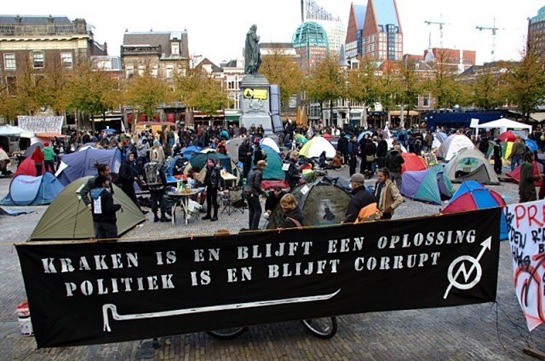
In protest, the kraak (squat) community pitched a tent village in Den Haag.  After the news that the bill had passed in the lower house, an uproar broke out in the tent village causing the parliament to take a recess and several arrests were made.

kraak

“Squatting is still a solution; Politics are still corrupt” From the squat community in Den Haag protesting against the bill to ban squatting.

The benefits of squatting in The Netherlands are many, including: a thriving anti-squatting industry, an end to speculation on property, maximization of space usage, and affordable housing for students (and anti-capitalists).

See more of the tent village

Read more about the bill

Wednesday, October 14, 2009

Tour de France 2010 in Rotterdam

The Tour de France will begin in Rotterdam next July, and if that is not amazing enough, the race will actually go through the building I am currently residing in, Het Poortgebouw!

gd_depart_2010_01 poortgebouw-tour-de-france

Here is information about the route of the tour, in particular the grand depart in Rotterdam.  The mayor of Rotterdam, Ivo W. Opstelten, wrote:

The Grand Départ of the Tour de France also gives us an opportunity to draw attention to another of the city’s ambitions. Under the motto “New Energy”, we are creating a link between sustainability, exercise, health and youth and the sport of cycling. The world needs new energy – sustainable energy that emits less CO2; new energy from cycling for and by the youth of Rotterdam.

That is right up my alley.  Check out the pretty sweet flyover of the Tour’s route:

Expect to see big things on the roof of Het Poortgebouw on the 3rd of July in 2010!

Friday, October 9, 2009

Two Succumb to Hunger

From Kenya National TV, reasons for increased urban migration:

Economic Crisis Hits the Urban Poor Hardest

Some of us may not feel the effects of the economic recession much, we can continue our schooling, buy groceries and afford small trips. Last night, I cooked a lentil soup for 7 persons, all the veggies (carrots, lentils, onions and potatoes) and spices added up to KSH180, approx €1.80. Little costs, unfortunately, still too great for some.

More than 80% of Nairobi’s slum population lives below the poverty line and cannot afford to put food on the table. Kenya’s slum dwellers have been hit hard by the food price crisis. Slum dwellers in Central Kenya are faced with extreme poverty (starvation), and are resorting to eating animal feed (24 August 2009, Concern).


The economic crisis is harsh on casual workers employed in the formal sector, informal sector workers and international and domestic migrant workers. As last reserves are used, the risks is exorbitantly high for the poor to rejoin the ranks of ‘extreme poverty’. Industries (especially the garment industry) are back to offering sweat shop conditions to the desperate (Voices of the Vulnerable).

Urban migration has increased in the recent months; due to aggravated environmental conditions (extreme drought). Migration is out of complete desperation, for a ray of hope. Funds only for a one-way bus fare. There is an urban humanitarian disaster at hand.

Sunday, September 27, 2009

Sunday Morning Video

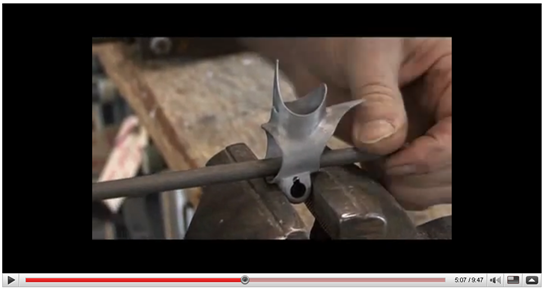
About 20 minutes of footage of an experienced bike building master in Amsterdam under the flag RIH.

image 

The video is what my old photography teacher would call “quiet”.  It is relaxing to watch this man’s tempered patience as he conducts his craft.

Friday, September 25, 2009

Ambroseli National Park

Although only 240km southeast of Nairobi, there is a 50km stretch that took almost three hours. Blame the tourist industry, for the overloaded trucks carry the luxurious comforts requested the wealthy tourists and road with deepening ridges.
We camped, down and dirty in the sand, under Mt. Kili’s air (heir). Unlike all other camping experiences, all trash (cans, wrappers, etc) is burned, so that the smell doesn’t attract wildlife. Nevertheless, a couple of hyenas paid visit during the night, they are harmless scavengers, but the roaring lion 2kms away is not.  
The National Park hasn’t received rain in over two years, Ambroseli lake has dried up almost completely. The grazers and hippos hang out in the small patch of swamp, and carcasses lie in every direction; the area stinks of death.
Mt. Kili has little snow left. It seems to live in its own biosphere; even at a distance one can notice/admire Mt. Kili’s unique environment.
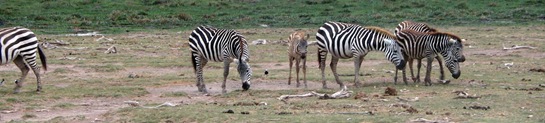
Giraffes, zebras, gazellies, wildebeests, weaverbirds, ele’s, warthogs, hippo’s, and even two lions mating on the early morning, birthday game-drive.
Africa’s beautiful landscape suffers from the lack of rain.

zebras

mt kili 

~Eline Bakker

Friday, September 18, 2009

Karibu Kenya

East Africa brings a whole new way of life. Nairobi is located at 1700m, chilly temperatures at dawn and dusk with a blazing sun at noon. Everything is dry. It hasn’t rained since May, and so the dams are empty and the water company is struggling to provide water. In fact, it hardly succeeds. Water tanks on rooftops are refilled every three days (although im counting 6 at my place) . During the day, electricity is provided to the industry, and at night to residences. Red soil dusts the air. Exotic flowers and bright birds line the streets; species that are similar to those found in Australia, like the , birds of paradise.
I live in what the interns have dubbed ‘slum gardens,’ for these plastic model homes find themselves amongst UN and embassy villas. Run by a thieving Indian woman, who doesn’t declare taxes, but happily rents out rooms for 200,00ksh +. Remove two zeros and that equals Euros. The homes model Dubai’s vision of upgraded slum houses, simple plastic structures, but the beautiful well-manicured garden makes up for the discomforts of woodworms and a grave-sunk mattress.
Otherwise, these are my observations:
• Traffic in Nairobi is a nightmare. No practical xeoms to catch a ride with, bicycle riding is out of the question (although there supposedly is one fixed gear rider...). Instead, the informal system of matatus (mini vans) takes ownership of the road. Doors fly open, hip music welcomes in a road side passenger, and at the sound of whistle sung by the man hanging out the vehicle, the matatu speeds away.
• Roads throughout the city are pott-holed.
• When El Nino comes, there is going to be a lot of trouble!! (The Urban Poor living along the major rivers are in dire straits!)
• There is no real center of town, instead there are areas.
• Most expat folk live in well-secured, high-fenced estates.
• Tribal hierarchy governs life (more on this topic later)
• Internet sucks here, but avocadoes cost 15ksh a piece!
• The Sunday hike up Ol Donyo (Buffalo) Mountain revealed no buffalos, but many baboons and blue headed monkeys crossed the path.

Sunday, September 13, 2009

Rotterdam

by Nels Nelson

Statue in the center

by Nels Nelson

by Nels Nelson

The Poortgebouw

IMG_4308

Off of the Erasmusbrug

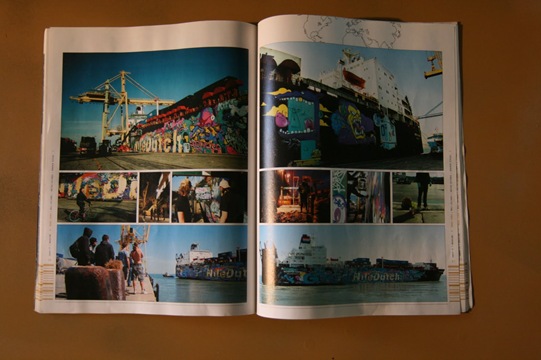
NileDutch Kwanza

“Hotel Kwanza”, a project with NileDutch (shipping company) and Bier en Brood (art collective).  Cool video on instillation in Black 10 gallery in Rotterdam.

hotel kwanza

niledutch

Sunday, September 6, 2009

Next new future soon to come

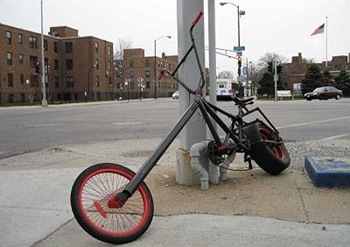
The year of the fixed gear bicycle has come and gone as far as the fad is concerned.  I will continue riding mine, as will many others, for the geometry and simplicity of the bicycle form.  But there is something else on the horizon… Chop Bikes!

mepha Surly’s chopper ‘Mephechopoles’ from Rat Patrol

Ed "Twisted" Santana: Kustom Chopper
With a plethora of old bicycles and parts lying around The Netherlands, it shouldn’t be hard to start putting on these together…

Thursday, August 13, 2009

Playing for Change: Chanda Mama

You’ve got to check out Playing for Change (peace through music).  This outfit has people from all over the world playing on a single track!

Here is some info about this song:

“This Song Around The World is a folk tune from Chennai, India. We started the track in New Orleans and added musicians from the across the globe before finally delivering it the people of it’s origin. We ended up in Chennai recording and filming the vocals from the Oneness Choir. The track has a feeling of perseverance and joy and features vocalists from four continents.”

Listen to the song!

Friday, July 24, 2009

The Longest Way 1.0

A man walks for 1 year across China and makes a website and a video.  Both are terrific, the inspiring video is below, and you should take the time to check it out:

The Longest Way 1.0 - one year walk/beard grow time lapse from Christoph Rehage on Vimeo.

Thursday, July 23, 2009

5 Days in NYC

Thank you to my friends for showing me a great time NYC earlier this week…  I had a great time enjoying the following activities:


I saw Dirty Projectors beside the Hudson River in Brooklyn with a crowd of beautiful people / the Williamsburg population.

dirtyprojectors 3740996969_abebabf0fa_o

Williamsburg waterfront | Dirty Projectors


I broke New York’s Open Container Law in McCarren Park, Brooklyn until after dark and then was taken to a Manhattan hotel roof bar by an off-duty homosexual bartender for free drinks with a great view of the NY night skyline.


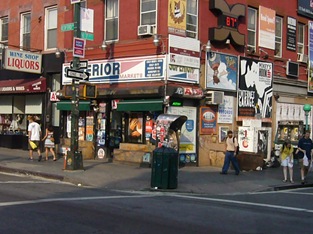
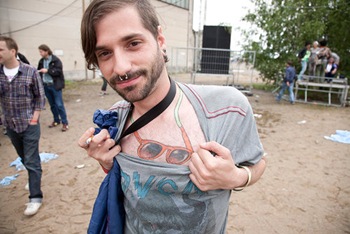
I crashed on David Rosenzweig’s couch on the corner of Driggs and Metropolitan in Williamsburg in his illegally-occupied windowless warehouse apartment, but a photo studio to make up for it.  He showed me his neighborhood in all its’ Hipstery goodness (been living under a rock? hipsterrunoff, hipster olympics); a barrage of tattoos (ironic or otherwise), fixed gear bicycles, interesting graffiti, ‘fashion’, coffee shops, bookstores, thrift shops, and creative industries.

 522495754_2e01f3c672_o hipster

Williamsburg | Random hipster photo


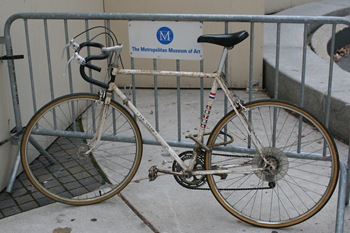
I rode my 1970’s road bike up Manhattan on a beautiful sunny day to Central Park and the Metropolitan Museum of Art where I saw Francis Bacon’s retrospective.  I also learned that the safest way to ride bikes in traffic in NYC is to go fast along with the traffic.

astraMET Francis-Bacon-portrait-of-george-dyer-riding-a-bicycle-1966 bacon_3studies1

My bike at the MET | Francis Bacon paintings


I also chilled in Union Sq., slept at an undisclosed recording studio on sound-proofing pads, avoided bedbugs, rode a mountain bike at sunrise through Prospect Park, climbed a statue, and modeled in a magazine photo shoot (kind of).

Wednesday, July 22, 2009

Golden Triangle

Where Thai Buddha meets Burma and Laos. Tollway (deepest point of the river) marks the borders. Borders always shifting…

Big Buddha, marking Thailand's territory.

While Nels has joined the hipster movement in Brooklyn, USA, Eline enjoys a family holiday through Northern Thailand. Travel by Mitsubishi Pajero, MRC Mekong Nico at the wheel, Susan the guiding GPS.

In Chiang Saen, we visit the Hall of Opium. Poppy plant, a long time ago grown solely for medicinal purposes, now a means to buy weapons and feed wars.

Just south of the Golden Triangle, we visit a Union of Hilltribes. An impressive fortress-wall gate leads to a collection of five hilltribes: Yao, Akha, Lahu, Lisu and Long-Neck Karen. Among a rich green jungle there is sadness, although the customs and traditional lifestyle is attempting survival, it is poisoned.

By the sound of foreign footsteps, hilltribe persons emerge from their huts, fixing their traditional dress, putting on their headdresses, and welcome with '50 baht', '100 baht' for handmade wares. Drum and dance is performed for those tourists wanting a show.

The Akha people believe that spirit and man once lived together until a spirit stole a tomato from man, and man a cucumber from a spirit. Since then, distinct differentiation is made between the spirit and human world. One enters an Akha village through a cleansing gate; when spirits one may have attracted during the jungle walk are sent back to the jungle. The Akha enjoy see-sawing and swinging on a four way parasol swing.

The Yao people enjoy a beautiful stature with their puffy red collars, like a European fur collar. They are from the Western Thailand. Here we met Leuh Kwauh, an older lady with a young spirit who specialised in embroidery patterns. To start interaction, I pull out my decade-long attempt to finishing a piece of embroidery. Yao women wear embroidered pants. With an opportunity to buy from the creator, I bought a piece and paid her well (say 'No' the Middle Man's gross profits). She presented a gift; a small photo of her AMONGST THE POPPY FIELDS. UNIQUE!


Leuh Kwauh in a poppy field, taken outside of her home village.

The Long-Neck Karen people seem to receive most of the attention. Their neckware is not light:

4 kg of neckware for an average Long Neck Karen woman

http://picasaweb.google.com/elinebakker/Thailand2009?feat=directlink

Thursday, July 16, 2009

Portrait of Amsterdam

This is what happens you add up: tilt-shift photography + stop motion video + Nike footwear's production budget + I AMsterdam + a Blogger named Nalden + a look into the creative city = a very cool portrait of Amsterdam, well worth watching!

The IAM1 Amsterdam Journey from Nalden on Vimeo.

Sunday, June 7, 2009

Daedelus at the Meet Factory

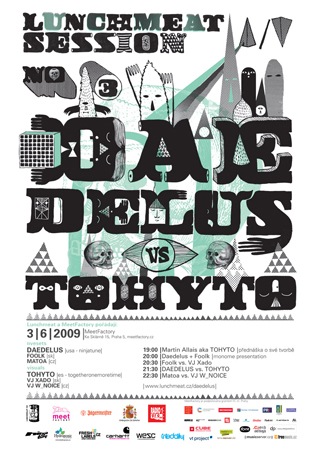
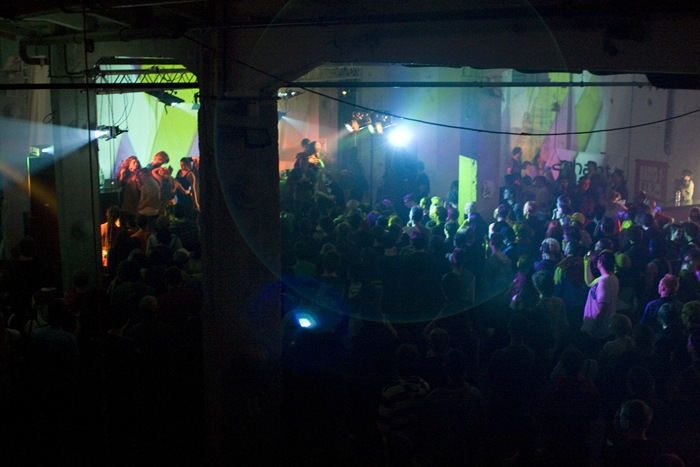
3 June, 2009, awesome concert!

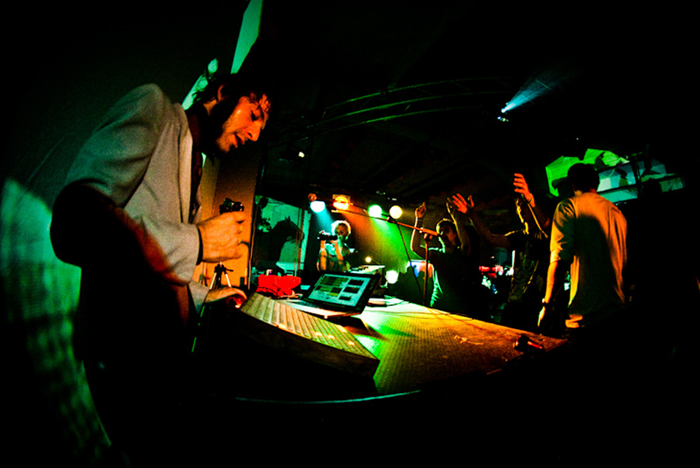
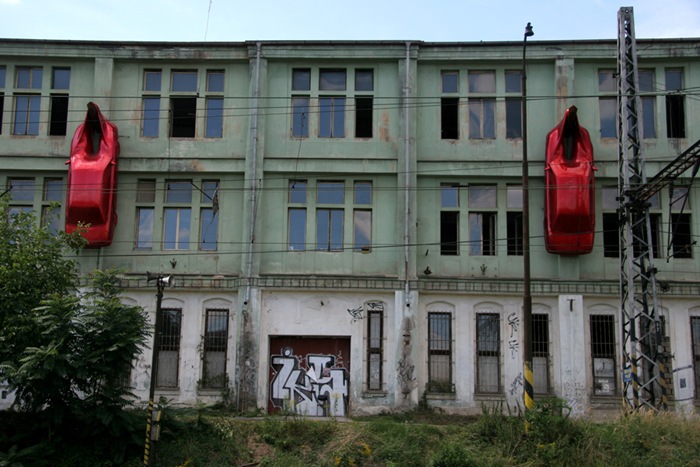
Daedelus with visual artist friend TOHYTO rocked the Meet Factory in Prague.  The Meet Factory is a squatted post-industrial building on a Prague brownfield.

daedelus-prague

Daedelus in the Meet Factory

untitled Gig information on Lunchmeat.cz

meet-factory2

Meet Factory

meet-factory

Meet Factory

by Nels Nelson

Daedelus at the Meet Factory

by Nels Nelson

Daedelus playing his Menome, an interesting instrument created by Brian Crabtree.  Watch a video of Daedelus explaining how it works.  Watch an artist interview video with Daedelus.

Thursday, May 14, 2009

World Games Solar Stadium

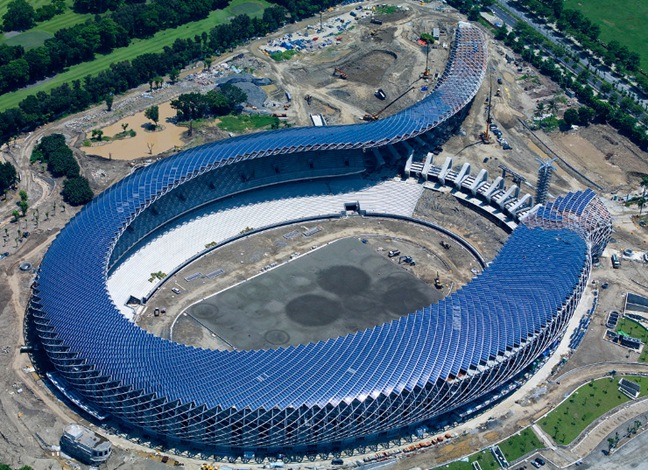
The World Games Stadium in Kaohsiung, Taiwan was completed in January for the upcoming 2009 games.  The astonishing feature of the stadium is the 14,155 m2 solar PV roof which will produce 1.14 gigawatt hours of electricity a year.  Furthermore, all materials are local to Taiwan and reusable.

From the World Games website:

The whole construction of the Main Stadium, with a capacity of 40,000 seats, designed by Toyo Ito… an international standard soccer field and facility, ensuring that it is the perfect venue for the opening and closing ceremonies, as well as the Rugby 7s and Flying Disc events.  The City of Kaohsiung is particularly proud of this project. During the construction period, no site accidents occurred, while the construction crew successfully overcame the technical difficulties presented by installing spiral steel girders and 8,844 solar panels on the roof.

That’s right, Ultimate is one of the many fringe sports that are part of the World Games, and it will be played in this amazing new stadium!  Check out this short promotional video for the new stadium, which opens with a disc being tossed:

I must confess this is the first I have heard of the World Games, which consists of 30 eccentric sports such as water skiing (including water ski jumping), surfing, life saving, tug of war, and bowling… see the entire list.  Hopefully this incredible new stadium will increase the event’s visibility.

world-games-stadium

Stadium under construction via

Wednesday, May 13, 2009

1605 Streaming Music

This website is currently streaming some really great electronic music tracks.  I don’t know how much longer the site will be up, so go listen now!  1605

danelektronike09_dj

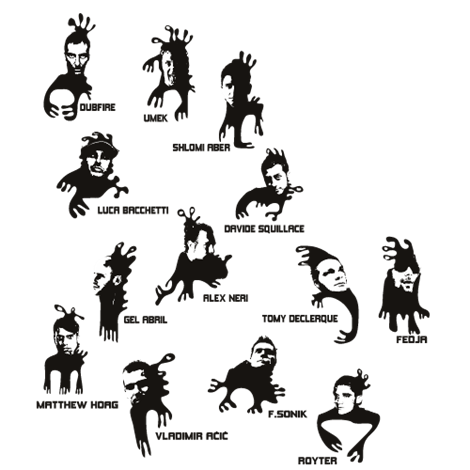
The visual design team for their website is here

Tuesday, May 12, 2009

Fontainebleau weekend

We got away from Wagstag for a weekend down to Fontainebleau, France for some bouldering in the famous forests.  It rained most of the time we were there, but we still got in a couple of problems and some nice hikes through the woods.

by Nels Nelson

Nels on top of a boulder in the Troi Pignon (Three Pigeon) forest.

by Nels Nelson

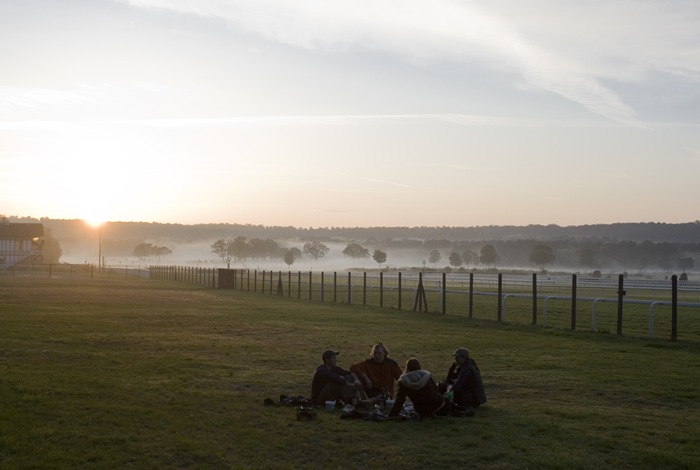
Camping near the racetrack.

by Nels Nelson

Coming home to the camp site after a night out in Fontainebleau.

by Nels Nelson

Fog over the racetrack.

n695013308_1789298_7222201

Making fire in a cave. Photo by Julia.

Wednesday, May 6, 2009

Bevrijdingsfestival (Liberation Day Party)

Liberation Day in Wageningen this year was an amazing event; the whole city was a giant music festival.  There were 19 music stages playing music from 13.00-midnight, each with its own genre including a terrific world music lineup, hip hop, electro, pop, rock & roll, and even a tent for old-people-music.  The normally sleepy city was transformed…

From our apartment window I took a 12 hour time-lapse video of the Wageningen Bus Station and compiled this video.  While the bus station was not the center of the action, there was a good view of the Veterans Parade and of the masses trying to leave around 23.00.  I set the camera up to take a photo each 30 seconds.  At night, an interesting effect occurred when the shutter speed was 30 seconds itself, resulting in continuous shooting and streaky light, check it out at the end of the short 2 minute movie:

Tuesday, April 28, 2009

YGTBKM

man bear pig man bird pig ok.

Sunday, April 26, 2009

Its light until past 9pm now

by Nels Nelson

David is Wageningen.

by Nels Nelson 

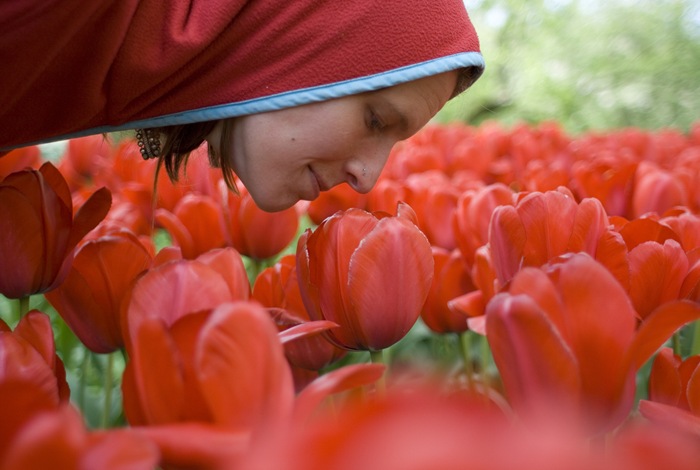
Eline with the tulips.

by Nels Nelson

Two operational road bikes on the dike road.